The POSITIONING
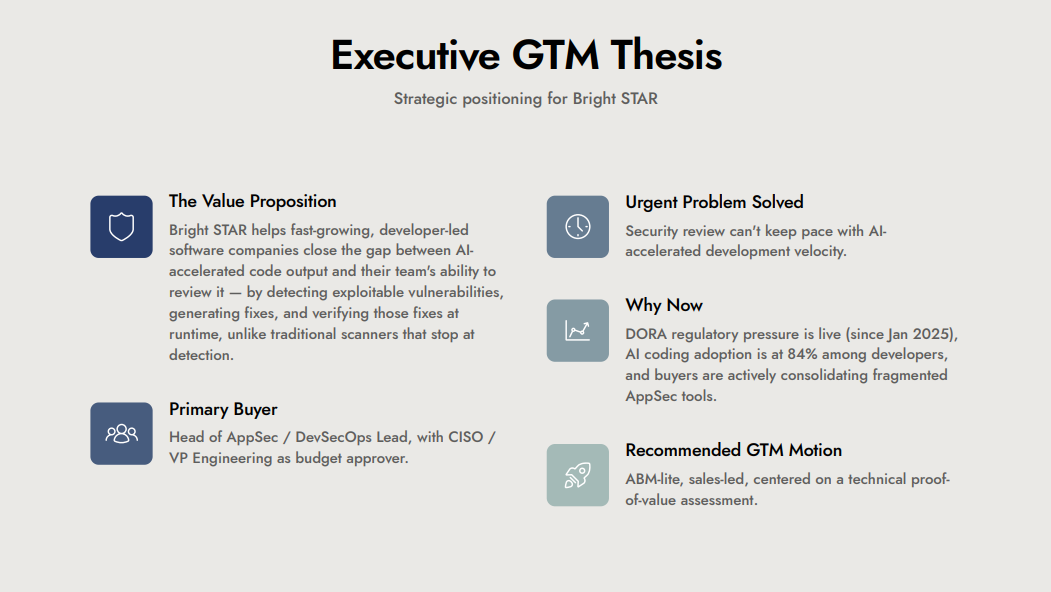
For fast-moving companies shipping code faster than they can secure it, Bright STAR is a security testing and remediation platform that doesn't stop at detection, it verifies the fix actually worked at runtime. Positioned against three tiers of competition: direct players like Invicti and Veracode, adjacent tools like Snyk, and the real alternative most buyers default to, manual pentesting or doing nothing at all.
THE CHALLENGE
Bright STAR needed a GTM strategy that could stand up to scrutiny in a market where AI-accelerated code output has outpaced security teams' ability to review it. The strategic bet: don't out-shout competitors on AI or accuracy claims, win the evidenced fight, developers and security teams are drowning in noise, and STAR's find-fix-verify loop solves exactly that.
THE BUYER
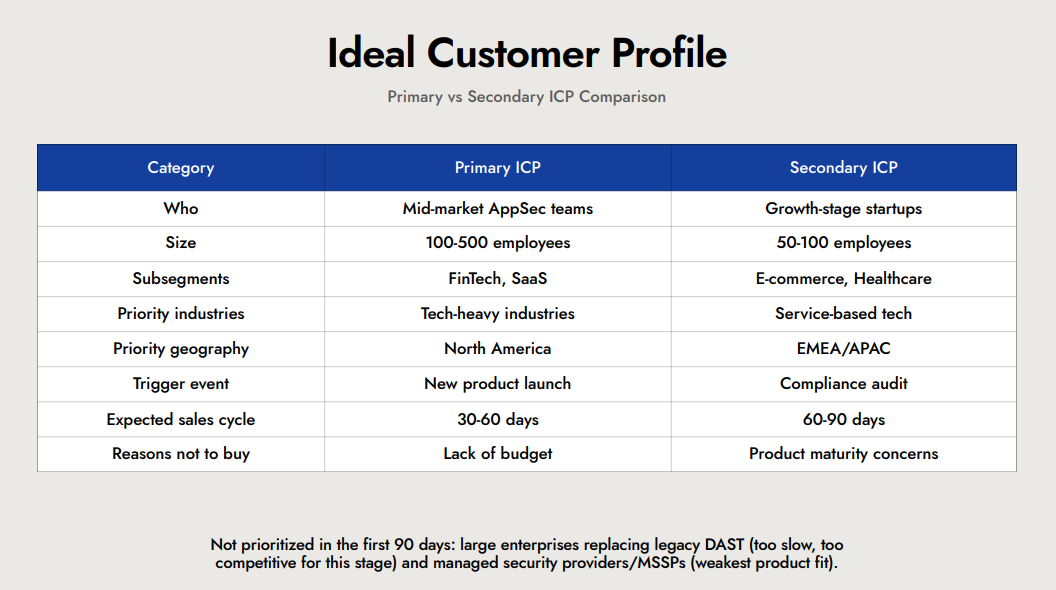
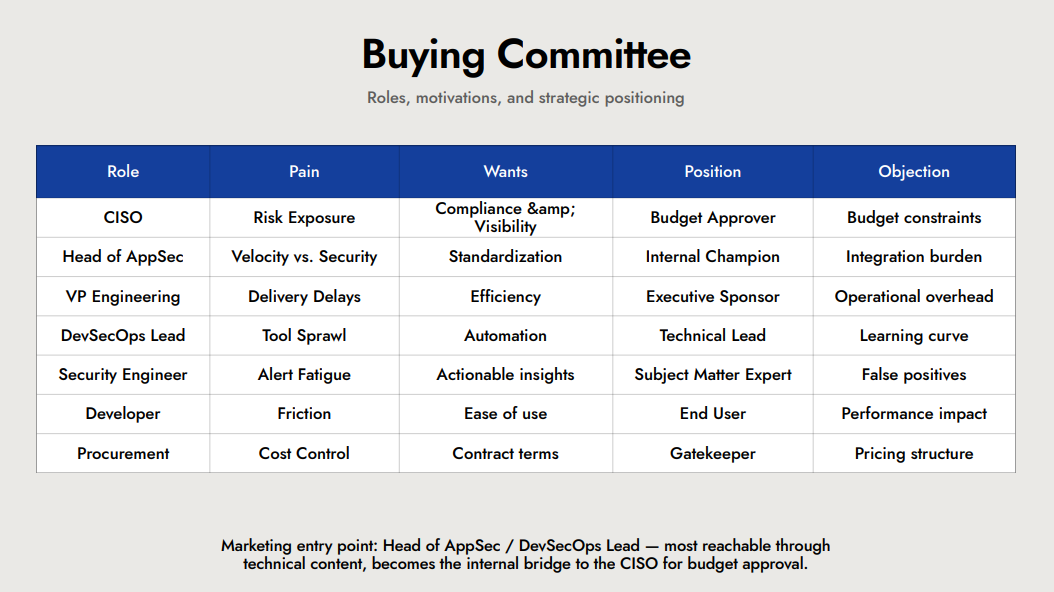
Primary entry point is the Head of AppSec or DevSecOps Lead, the most reachable through technical content, who becomes the internal bridge to the CISO for budget approval. Mapped the full buying committee, from developer to procurement, each with a distinct pain point and a distinct objection to plan around.
THE CAMPAIGN ARCHITECTURE
Three campaigns, each targeting a different angle on the same urgency: false-positive fatigue, AI-generated code risk, and the shift from detection to verified remediation. Each campaign carries its own audience, message, offer, and KPI, built to run in parallel and be compared against each other.
Bright STAR
A full go-to-market strategy for a B2B cybersecurity platform, from ICP and buyer psychology through a 90-day execution plan with budget modeling.
THE FUNNEL AND THE NUMBERS
The funnel model tracked progression from target accounts to engaged accounts, qualified meetings and potential customers. Each stage included a decision gate to guide optimisation during the first 90 days.
For example:
-
If engagement fell below 8%, reassess targeting, message or channel.
-
If qualified meetings fell below 15% of engaged accounts, review the offer and conversion path.
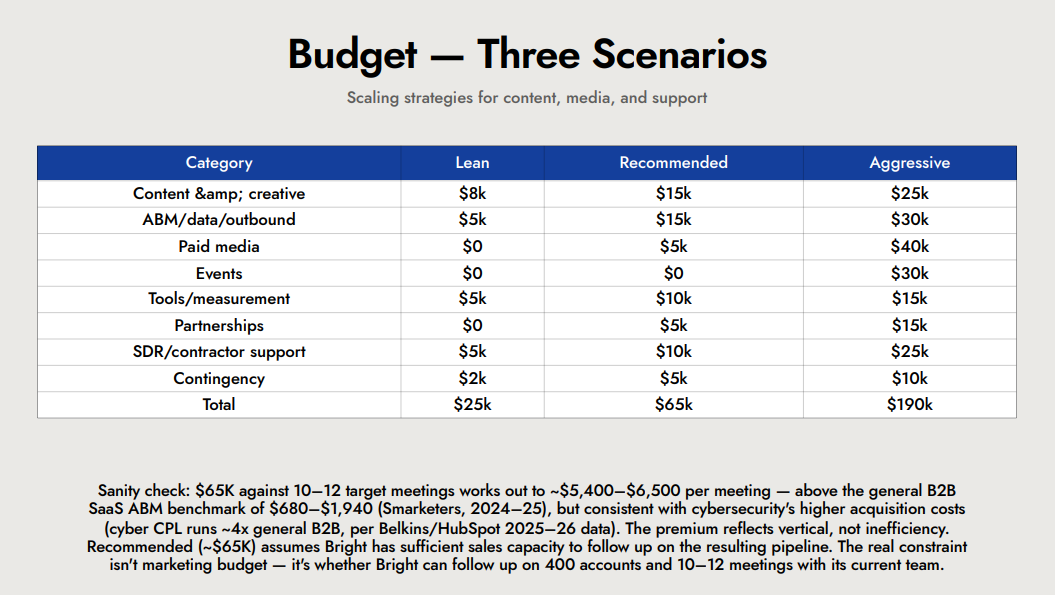
Three budget scenarios were modelled and the recommended option was stress-tested against relevant B2B ABM benchmarks. The model was designed to support decision-making rather than create false precision.
Note: Engagement and meeting thresholds are planning assumptions used for optimisation gates, not reported campaign results.
The Verdict
The recommended plan was a 90-day execution roadmap with owners, milestones, budget scenarios and a Day-30 recalibration point. The objective of the first 90 days was not to promise closed revenue before the funnel had been validated. It was to establish whether the priority audience, positioning, campaign offers and conversion path could generate qualified engagement and sales conversations.
The strategy therefore treated the first 90 days as a learning and validation period, with clear evidence required before scaling investment.
Disclaimer: Prepared as an evaluation assignment for a Marketing Manager role at a growth marketing agency, using their client's real security product as the case study. Independent work, not used by the agency with the client.